The Role of Performance and Lifecycle Marketing in an AI Era
AI is reshaping performance and lifecycle marketing by automating repetitive work while shifting marketers towards strategy, context-building, creativity, and human judgment.
Marketing has always been a resource-intensive discipline, especially in performance and lifecycle marketing. While consumers see the output – television commercials, magazine ads, promotional emails, and social media ads – the process of creating effective marketing is complex and time-consuming.
There are many detailed steps and a lot of grunt work involved in generating marketing campaigns. In the AI era, when you have repeatable processes with many mundane tasks, those processes are ripe for AI automation. I’ve spoken to many performance/lifecycle marketers who fear that AI will take their jobs.
In some cases, that’ll be true, but I believe that marketers need to look at the big picture and consider how their roles will evolve in an AI era.
The Current Marketing Process
After over one hundred years of marketing, it’s still deceptively difficult. Let’s say you wanted to run a brand-new marketing campaign at your organisation. What would you have to do? How long would it take? Most marketing campaigns begin based on research or a need to improve sales.
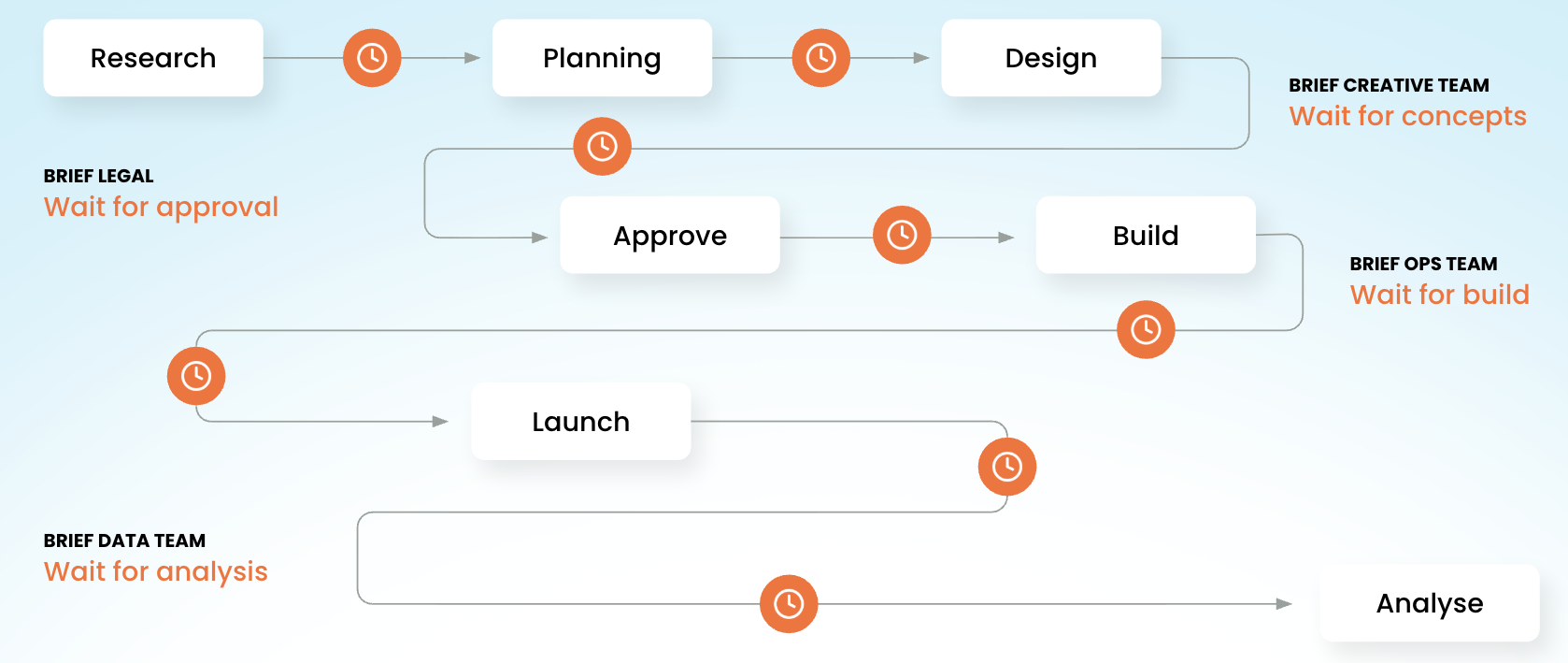
After conducting research, the marketing team needs to determine the best marketing channel – email, television, social, out-of-home, print, or a combination of several of these. Next, the marketing team has to develop creative ideas for the campaign. After that, marketing develops creative concepts (copy and imagery). Creative concepts then go through several rounds of approval.
Once the campaign and its creative elements are approved, marketers use customer data to define the target audience. Next, the campaign is deployed. Finally, the marketing team uses data analysis to assess the campaign’s impact.
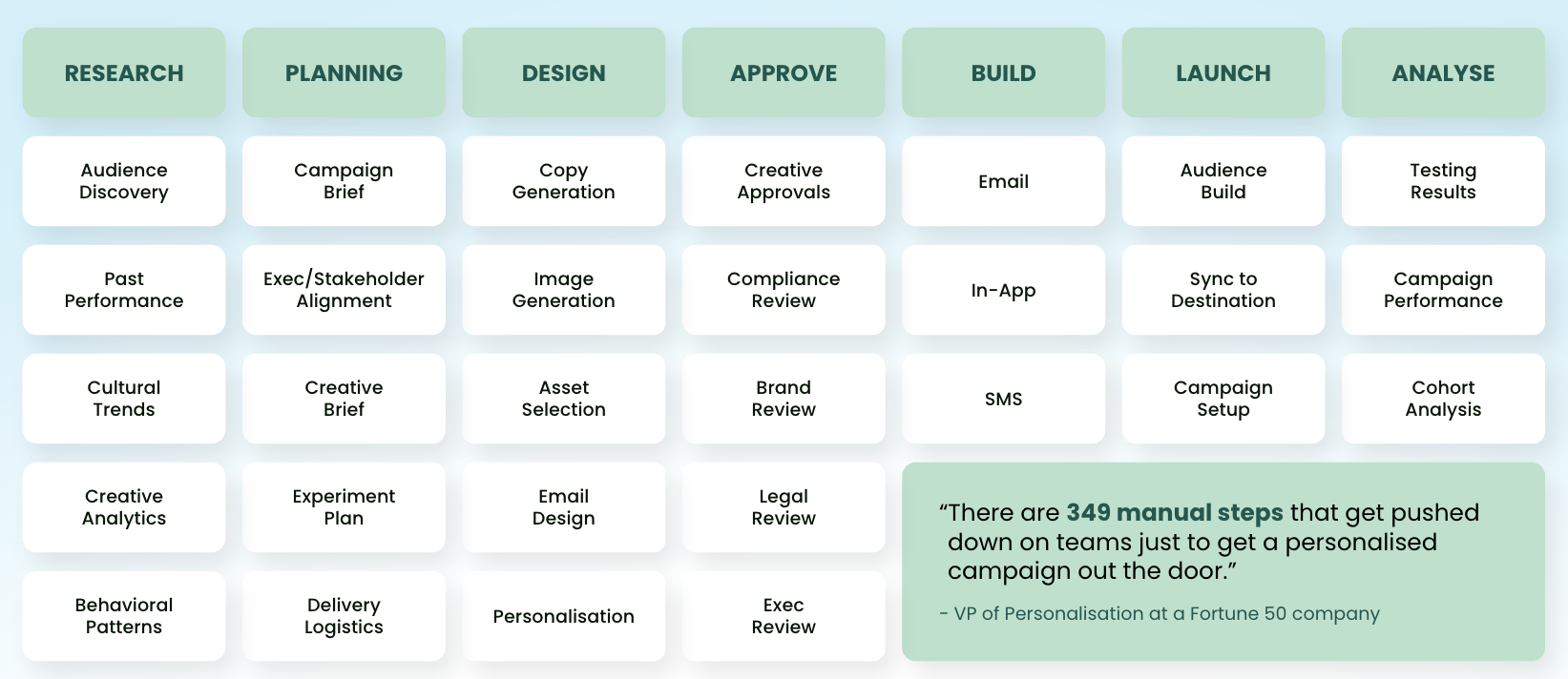
The preceding marketing process can sometimes take weeks to complete and often involves many different people and marketing teams. This timeline is often extended further when you account for the time lags between process steps.
The AI Paradigm Shift
As you can see, there are many steps, teams, and approvals involved. But these processes were built for a human-centric approach to marketing. The preceding workflows assume that human resources will do all the work.
But as we’ve seen in the past few years, there are many situations where AI can expedite and improve upon human work products.
For example, it could take a research analyst a week to review all past marketing campaigns, determine which ones performed best, compare them to the current campaign, and analyse competitors’ campaigns. But AI can accomplish the same work in a matter of minutes.
Similarly, it could take a design team weeks to generate potential campaign images for emails or online ads, while AI could produce hundreds of them in under 20 minutes. Routing campaign briefs, copy, and images for approval can take weeks and involve handoffs between different stakeholders and systems.
But AI could intelligently route approvals and even suggest or flag changes based on past learnings.
Many of the campaign steps outlined above could be streamlined using AI. In most cases, AI should shoulder the load, since it involves time-consuming, repetitive work. While marketers may fear losing their jobs, I don’t think many want to spend weeks developing new copy and producing hundreds of image variations.
Most marketers would prefer to spend their time applying judgment and taste to the marketing process. For example, while AI can create hundreds of campaign images, only humans can evaluate them and determine which are “on brand” or convey the desired message/feeling.
When AI does the busy work, and humans apply taste and judgment, everyone wins.
Semantic and Context Building – The Future of Marketing
Before AI can help marketers streamline the mundane parts of marketing, it needs to learn to be a marketer. AI by itself would not be a great marketer. It wouldn’t understand your organisation, its goals, its products/services, its differentiators, its value proposition, etc.
In many ways, attempting to leverage AI for marketing is akin to hiring a new marketing employee and having them produce campaigns on their first day without knowing anything about the organisation and its products.
That would be a recipe for disaster!
Therefore, in addition to applying approval, taste, and judgment, one of the most critical roles for marketers in the future will be context building. Instead of marketers doing the actual work of marketing, they will increasingly spend time teaching AI tools about the organisation, its products, and its brand guidelines.
To truly harness the power of AI, marketers will have to build robust semantic and context layers that guide AI through marketing activities. In a world where all companies have access to similar AI capabilities, the differentiator of the future may be which organisations’ semantic and contextual layers are better than their competitors’.
In the future, marketers will devote more time to leveraging multiple systems to construct semantic and context layers. These layers will absorb all customer data, past marketing campaigns, brand guidelines, tone, and style. Marketers will also have to help the semantic and context layers understand corporate constraints, such as financial or privacy regulations.
In effect, marketers will be responsible for creating a virtual “super-marketer” that knows everything about the organisation, so AI can leverage that knowledge to help them generate marketing assets and audiences.
In this regard, marketers will have to take one step back to take two steps forward. While they are still running current campaigns, marketers will have to begin the difficult work of assembling all this marketing information.
Traditionally, marketers haven’t been great at consolidating marketing data and applications. It’s common for customer and marketing data to be spread across multiple Martech tools.
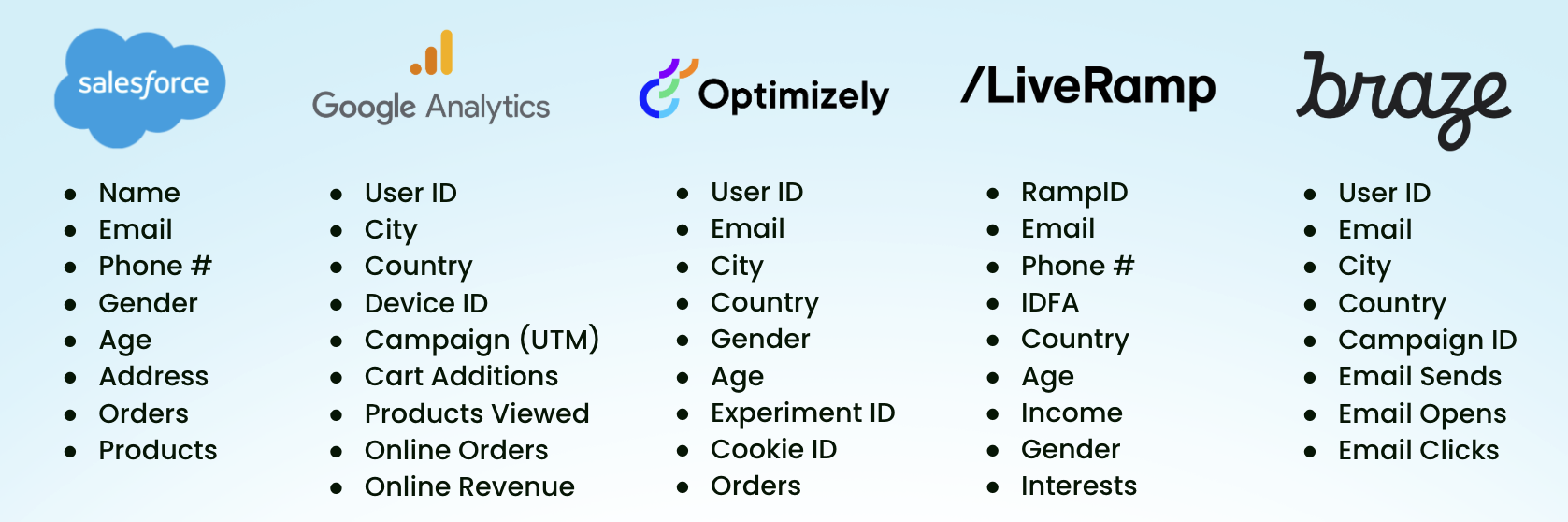
In addition, knowledge about brand guidelines, tone, and style often lives in Google Docs or Notion, or worse yet, only in people’s heads!
For better or worse, AI has shone a light on this problem of marketing data sprawl. Organisations have learned that AI requires consolidated, trusted data to be effective. Attempting to run AI across multiple data stores or on unverified information can lead to hallucinations or the amplification of incorrect information.
This learning has motivated many organisations to consolidate customer and marketing data on cloud platforms (Snowflake, Azure, Google Cloud, etc.) and agentic marketing platforms.
Hence, over the next few years, many marketers will split their time between running active campaigns and building the semantic and contextual layers that AI needs.
This marketing curation will soon become an essential skill. Marketers will need to understand where customer and marketing data reside, consolidate them, and keep them up to date. Once marketers are successful in context curation, AI tools will be empowered to produce many of the assets that are currently created manually.
Then, marketers will employ their creativity, taste, and judgment to steer AI tools in the right direction. As AI tools learn what marketers like and which assets and campaigns are successful, this information will feed back into the semantic and context layers, forming a continuous improvement loop.
Final Thoughts
Over the past decades, marketing has been in a constant state of change. In the early 2000s, marketing shifted from analogue to digital. By 2010, marketing was heavily focused on mobile. Today, AI is the latest change agent.
While marketing platforms and technologies have evolved over the years, the marketing process has remained complex and arduous. Despite decades of technological advancements, it still often takes weeks to roll out new campaigns, and even those are not highly personalised.
AI represents a massive change in marketing, enabling the automation of many repetitive tasks that have traditionally slowed it down. AI tools will allow marketers to conduct research, produce strategy/creative briefs, generate unlimited campaign copy and images, and route these through approval cycles.
Marketers, armed with AI, may finally be able to generate the types of near-real-time, personalised marketing campaigns they have promised for decades. But along the way, many of the roles historically performed by marketers will shift to AI agents.
However, in this new era of AI marketing, marketers will discover new roles. Marketers will help build semantic and context layers to train AI tools. Building these knowledge layers will require consolidating customer data and brand knowledge.
Once these semantic and context layers are built, AI will help marketers accelerate their output and give them the time to apply the taste, style, and judgment that only humans can provide.
ALSO READ: Why Faster Marketing Decisions Still Depend on Better Measurement