The Real Reason Short Dramas are Eating the App Store Charts
ReelShort and its rivals didn't win on story alone. Their real edge is a data-driven acquisition and monetisation engine built like a game.
Topics

As ReelShort, DramaBox, and other short-drama apps take the global app store charts by storm, the industry has been busy exploring what makes a 60-second episode so irresistibly engaging. But the success of short dramas has never been just about those 60 seconds. What truly deserves attention is the performance marketing, UA, and monetisation mechanisms driving this explosive growth.
The 60-Second Drama Blitz
In November 2023, ReelShort topped the U.S. iOS Entertainment free app chart. Over the following months, DramaBox and ShortTV (now renamed ShortMax) also climbed into the top ranks across North America, Europe, Southeast Asia, and other major markets. Almost overnight, “short drama” emerged as a new buzzword across the global internet industry.
As more short-drama players entered the market, the category had already grown into a multi-billion-dollar global market by 2024. What is even more striking is that, according to forecasts, the market is expected to surpass $10 billion in 2026, making short dramas a new variable in the global app economy.
However, attributing this explosive growth simply to compelling content would be an oversimplification. Their real competitive edge lies in stitching together content products, performance advertising, and gamified monetisation into a high-turnover business machine.
The Arbitrage Logic: Making the Unit Economics Work
The Paid User Acquisition Flywheel
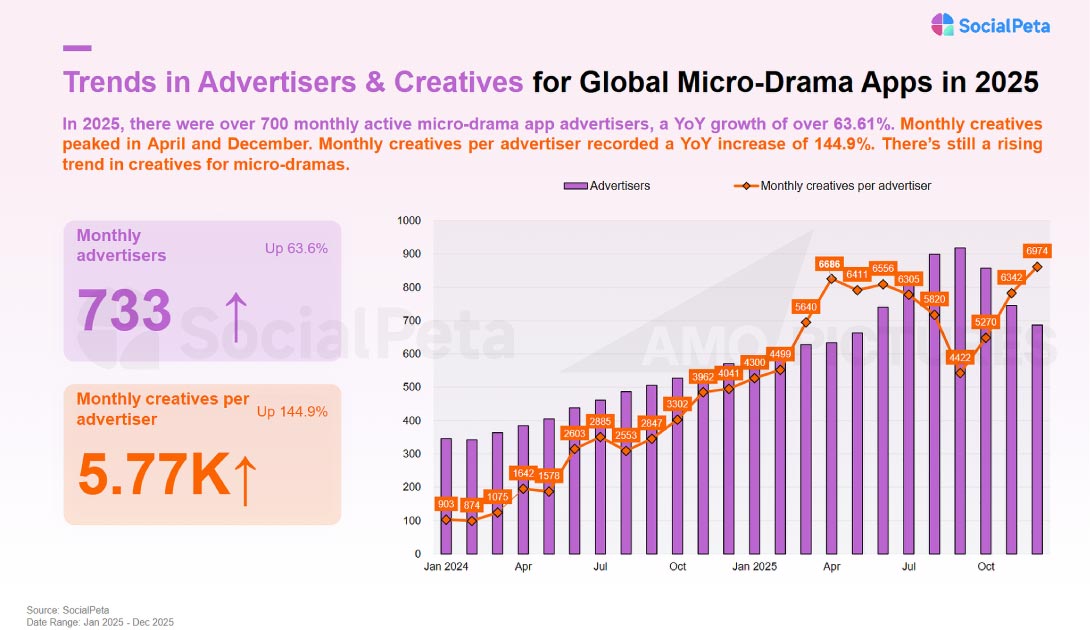
The growth engine of short-form drama apps is not organic traffic but large-scale performance advertising. This was already evident in SocialPeta’s previous short-drama white paper: in 2025, the average short-drama app deployed around 5,770 deduplicated ad creatives per month, while major players were running campaigns with creative volumes reaching well into the millions.
Unlike Netflix, which relies heavily on brand awareness, content reputation, and organic acquisition, ReelShort and its peers pursue a fundamentally different strategy: continuously buying users through channels such as Meta, TikTok, and Google UAC, then using sophisticated operations to ensure that LTV covers the cost of each install. It is essentially a real-time battle fought through metrics.
According to industry estimates, leading short-drama apps in North America have a user payback period of roughly 30 to 90 days. This means UA teams must determine the monetisation potential of a specific creative or genre within an extremely short window—and quickly shut down underperforming channels. This highly data-driven acquisition model makes short-drama apps look more like ecommerce or mobile gaming companies than traditional content platforms.
And perhaps even more fittingly, as AI dramatically accelerates short-drama production, industry insiders have begun comparing the process of producing AI-generated dramas to “gacha” in mobile games—a surprisingly apt parallel, considering how closely the two business models are converging.
Content is the Funnel, Not the Product
Under the traditional streaming model, content is the asset that keeps users on the platform. But in short-drama apps, each drama is, first and foremost, an independent user-acquisition unit.
The suspense hook in the first three seconds, the cliffhanger at the end of every episode, and even the subtle facial expressions on the cover image are all designed to improve ad click-through rates and landing-page conversion rates. Operations teams conduct extensive A/B testing on the same drama, experimenting with different titles, covers, and edits before selecting the version that can outperform competitors in the feed. Content here is not the destination—it is the very top of the funnel.
It is also worth noting that successful short dramas that have already been validated by the market often generate numerous derivative versions, a model that closely resembles that of the mobile gaming industry.
At its core, this is a creative model built around proven content formulas + incremental innovation. A story may be adapted into a different genre, localised into multiple languages, or transformed into a new format: a live-action short drama can become a comic short drama, while a comic IP can be turned into an AI-generated, photorealistic short drama.
The goal is not to create everything from scratch, but to use market-validated hits as a foundation, then rapidly produce new versions through localised modifications and format migration. This reduces the cost of trial and error while increasing the probability of commercial success.
Hybrid Monetisation: Subscriptions + Microtransactions
Once users are drawn into the app by advertising creatives, the monetisation design further demonstrates the model’s sophistication. Short-drama platforms generally adopt a three-tier monetisation structure: subscriptions (weekly/monthly passes), pay-per-episode unlocking (in-app purchases priced in currencies such as Coins), and an ad-supported free tier.
The key to this hybrid model is to lower the barrier to payment while increasing average revenue per paying user (ARPPU). Unlike Netflix, where users must commit to an entire month’s subscription upfront, short-drama apps let users spend as little as $0.99 to unlock the next episode.
But once users become hooked on a story, their cumulative spending can easily exceed the cost of a traditional subscription. Combined with the near-zero marginal cost of digital content, this model can deliver exceptionally high gross margins once the economics are proven.
Learning from Mobile Games
Mobile Gaming DNA
Open any leading short-drama app, and its UI and UX reveal a distinct mobile gaming influence: daily check-in rewards, limited-time discount pop-ups, loot-box mechanics, VIP tier systems, and more. The goal is simple—to transform the passive act of watching dramas into a habit driven by daily tasks and rewards. These designs draw directly on the mobile gaming industry’s deep understanding of user psychology, effectively gamifying content consumption.
Mini-Games as a Retention Moat
One notable trend is that some short-drama platforms have begun integrating hyper-casual mini-games, such as match-3, merge, and story-choice games. This strategy serves a dual purpose.
First, it fills the gaps between episode updates and boosts DAU and retention. Once users finish the latest available episodes, mini-games give them a reason to stay in the app instead of immediately switching to TikTok or other entertainment platforms.
Second, it creates an additional layer of monetisation. Mini-games typically monetise through IAA, complementing the IAP revenue generated by the dramas themselves. This means the same user base can generate additional ad revenue for the platform without increasing IAP spending.
The LiveOps Model
Short-drama platforms have also borrowed the concept of LiveOps from mobile gaming: holiday-themed exclusive series, limited-time free episode unlocks, and community polls that let fans influence a story’s direction. These initiatives create more than just content updates—they create a sense of events.
On traditional streaming platforms, users enter a content gap after finishing a series and may cancel their subscriptions at any time. Short-drama platforms, by contrast, use a steady stream of engagement campaigns to break the user lifecycle into a series of continuous event-driven touchpoints, extending the overall app lifecycle and reducing churn caused by users simply running out of content.
The Bigger Picture: What This Means for the App Economy
The rise of short-drama apps is triggering ripple effects that extend far beyond the content industry itself.
First, it is redefining the monetisation ceiling for content apps. Traditional streaming services such as Netflix and Disney+ rely primarily on subscriptions, which can feel cumbersome and carry a relatively high barrier to entry in emerging markets. The hybrid monetisation model adopted by short-drama platforms demonstrates that microtransactions, subscriptions, and advertising can coexist within a content app—and do so more efficiently. This is forcing the entire industry to rethink how paywalls should be designed.
Second, short-drama creatives have become one of the largest non-gaming advertising categories by spend on platforms such as Meta and TikTok. The influx of UA budgets is directly driving up the cost of traffic, creating a crowding-out effect on other performance-marketing-dependent industries, including ecommerce and utility apps.
Looking ahead, short-form drama platforms could evolve into super apps. Once they control content, gaming, social connections, and users’ payment habits simultaneously, integrating ecommerce, local services, or additional forms of entertainment may become only a matter of time.
What they are competing for may not simply be users’ time spent watching dramas, but a position as the next major gateway to mobile traffic.
Conclusion: The 60-Second Moat
The true moat of ReelShort and its peers has never been any single hit drama. Content can be replicated, scripts can be remade, and actors can be poached. The real barrier to entry lies in the precise interplay of three capabilities: data-driven advertising efficiency, the responsiveness of localised content supply chains, and the psychological pull of gamified retention design.
As global app growth enters an era of increasingly fierce competition for existing users, these platforms have demonstrated a truth long overlooked: innovation in monetisation models can be far more disruptive than innovation in content formats.
A 60-second short drama is not merely reshaping the art of storytelling—it is rewriting the fundamental economics of the global app economy.
ALSO READ: The Role of Performance and Lifecycle Marketing in an AI Era
Topics
About the Author
Gordon Sun is a Senior Analyst at SocialPeta. He specialises in market research and competitive intelligence across fast-growing internet verticals, with deep domain expertise in short dramas, mobile applications, and the globalisation of digital content. His work covers industry dynamics analysis, emerging trend tracking, and the delivery of data-driven strategic insights for global digital markets.
View More