The Synthetic Creativity Trap: Why Brands Need to Get Messy to Stay Real
AI has erased the gap between zero and “good enough,” but in doing so, it is pushing brands towards sameness. As synthetic creativity floods the market, marketers must prioritise messy, emotional, human storytelling to stand out and rebuild real connections.
We’ve reached a strange, “frictionless” point in history where “vibe coding” can build a prototype in an afternoon and an LLM can generate a thousand personalised email variants before you’ve even finished your first cup of coffee.
The gap between zero and “good enough” has effectively vanished. And while that might feel like a superpower, it is actually a trap that is quietly making most brands invisible.
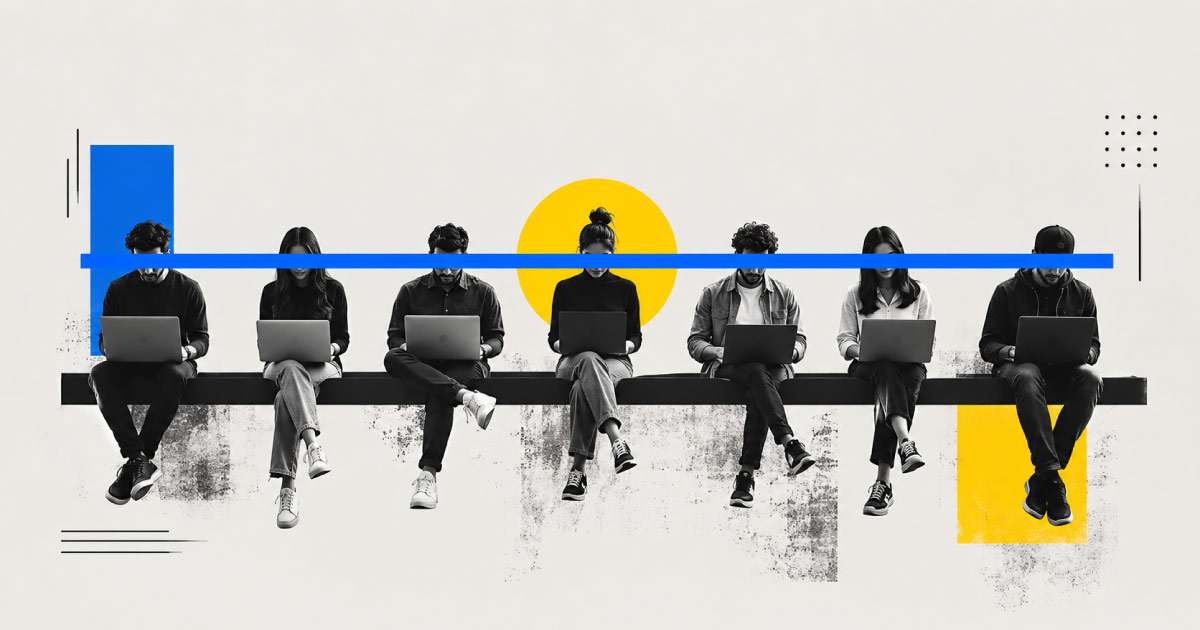
It’s like being in a fun house full of mirrors where every marketer is logged into the same three LLMs and asking the exact same questions about “how to stand out in a crowded market” and getting the same image back.
Like a corporate potluck where every single person showed up with the exact same pre-packaged potato salad from Costco (which don’t get me wrong, I like potato salad, but not as my ONLY option for food!).
When you ask ChatGPT to “define your competitive differentiator,” it reaches for the most statistically probable answer, which means you and your three biggest competitors are currently staring at the same generated list of “innovation, reliability, and customer-first values” while wondering why your brand feels like a ghost in the machine.
So if your brand narrative is built entirely on the patterns and probabilities that AI provides, you aren’t actually creating anything new; you are just participating in a massive, global race toward the centre of the bell curve. BORING!
The Seduction of the Optimised Average
“Synthetic creativity” is a miracle of efficiency, but efficiency is often the enemy of the “aha” moment. When you use AI to synthesise customer feedback or write your B2B brand story, the machine is doing exactly what it was trained to do by identifying the most common patterns and smoothing out the edges.
It takes the messy, contradictory, and deeply human frustrations of your customers and turns them into “pain points” that sound identical to every other competitor in your space.
Research from the Journal of Interactive Marketing released late in 2025 confirms what many of us feel instinctively: as AI-generated content floods the market, the emotional connection between brands and people is cratering.
We are seeing a “slop tsunami” where every B2B white paper and every SaaS homepage starts to feel like a sanitised, uncanny-valley version of a human thought. Real storytelling is not about being correct or optimised.
It is about being undeniable and finding the specific nuance that an algorithm would discard as a statistical outlier.
The “Aha” Moment: Why B2B Must Get Emotional
There is a persistent, dangerous lie that B2B marketing should be purely logical. Even in the highest-stakes enterprise deals, the person holding the pen is driven by a complex cocktail of ego, anxiety, and hope.
A study from the research firm Lippincott suggests that in 2026, “human-made” will resurface as a badge of honour and a driver of price premiums because buyers are becoming weary of the digital noise.
The “aha” moment in a story isn’t the part where the product saves $50,000. It is the part where the customer realises they can finally stop working on weekends and go to their kid’s soccer game.
AI can extract the data point that “the customer is frustrated with onboarding,” but it cannot feel the exhaustion in a founder’s voice when they describe how that delay caused their best developer to quit.
As Gartner recently predicted for 2026, the industry standard will become a “hybrid AI model” where machines handle the routine tasks while humans are required for the complex, emotionally charged interactions.
If you aren’t digging for those messy, inconvenient truths in your customer calls, you aren’t storytelling. You are just processing data.
What Marketers Can Do About It
If you want to survive the rise of synthetic creativity, your job is no longer to be a content creator. You are now a curator of human experience. You have to be the one who looks at the AI-generated draft and asks where the part is that makes you feel uncomfortable or real.
Here are 3 things marketers can do now to escape this:
1. Stop using AI as a writer and start using it as an ethnographer
An ethnographer is a researcher—often a cultural anthropologist—who studies and describes the culture, customs, and social behaviours of specific groups, communities, or organisations.
They immerse themselves in the daily lives of people, using participant observation and interviews to understand the world from the participants’ perspective. So instead of asking AI to “write a blog post,” ask it to analyse 50 customer call transcripts and find every instance where the speaker paused or sounded hesitant.
That hesitation is where your real story lives. AI gives you the GPS coordinates, but the human marketer is the local guide who knows the shortcut through the alley with the best tacos.
2. Focus on “Un-codable” Nuance
AI cannot do irony, it cannot do deep-seated cultural nostalgia (give me all of the elder emo/punk rock vibes from the early 2000s!), and it certainly cannot do vulnerability.
If your B2B brand story doesn’t have a moment where you admit you messed up and share what you learned, it won’t land in 2026 because people trust brands that admit they are human.
3. Shift from Volume to Value
We are in a zero-click world where AI agents often read your content before your customers do. To break through, you need to invest in “owned” high-value experiences that AI cannot easily replicate.
Let’s look at some examples…
Branding Gone RIGHT (The Human Enhancers)
These brands used AI as a power-up for human creativity, not a replacement for it.
1. Nike: “Never Done Evolving” (Serena Williams)
- The Play: Nike used AI to analyse 18 years of archive footage to simulate a match between 17-year-old Serena and 35-year-old Serena.
- Why it worked: It didn’t use AI to generate a fake Serena; it used AI to celebrate the human evolution of a legend. It turned data into a narrative about grit and growth that felt 100% authentic to the brand.
2. Heinz: “Ketchup AI”
- The Play: Heinz asked AI image generators to “draw ketchup.” The AI consistently produced bottles that looked exactly like Heinz.
- Why it worked: This was a masterclass in using AI as social proof. By showing that even a “neutral” machine thinks Ketchup = Heinz, they reinforced their iconic status without a single line of traditional copy.
3. Nutella: “7 Million Unique Jars”
- The Play: Nutella used AI algorithms to generate 7 million unique label designs for their jars in Italy.
- Why it worked: It solved the B2C scale problem. It made a mass-produced product feel like a limited-edition collectable. AI handled the “heavy lifting” of the design, but the value was the unique human experience of owning something one-of-a-kind.
4. Sephora: “Beauty Mosaic” (2025)
- The Play: Sephora used AI to scan 140,000 skin tones and turn them into a massive digital art installation.
- Why it worked: It turned “data collection” into a celebration of inclusivity. Instead of just using AI for “match my foundation,” they used it to visualise the beauty of human diversity, making the tech feel like an empathy engine.
5. Virgin Voyages: “Jen AI”
- The Play: A virtual Jennifer Lopez allowed users to create personalised video invitations for their friends to join them on a cruise.
- Why it worked: It was self-aware and playful. It didn’t try to trick people into thinking J.Lo was actually talking to them; it invited them into a co-creation game that made the brand feel accessible and high-tech at the same time.
Branding Gone WRONG (The Synthetic Fails)
These brands tried to automate “soul,” and the audience recoiled.
1. Google: “Dear Sydney” (2024/2025)
- The Play: An ad showing a father using Gemini AI to help his daughter write a fan letter to an Olympic athlete.
- Why it failed: It automated a heartfelt human connection. The entire point of a fan letter is the effort of writing it. By suggesting a child should outsource her admiration to a machine, Google accidentally branded itself as the tool for “emotional laziness.”
2. Coca-Cola: “Holidays Are Coming” (2024/2025)
- The Play: Coke released an AI-generated version of their classic Christmas truck ad.
- Why it failed: It hit the “Uncanny Valley” hard. The trucks looked too perfect, the lighting felt “synthetic,” and it lacked the grainy, warm nostalgia people associate with the holidays. For a brand that literally owns “The Real Thing,” going “The Synthetic Thing” felt like a betrayal of their identity.
3. Levi’s: AI Diversity Models (2024)
- The Play: Levi’s announced they would use AI-generated models to “increase diversity” on their site.
- Why it failed: It was seen as Diversity without Investment. Critics pointed out that if Levi’s wanted more diverse models, they should just hire diverse humans. Using AI felt like a cost-cutting shortcut to avoid doing the actual work of representation.
4. Air Canada: The “Lying” Chatbot
- The Play: An AI chatbot hallucinated a bereavement fare policy, leading a customer to overpay.
- Why it failed: A total Accountability Gap. The brand tried to argue in court that the chatbot was a separate legal entity. It proved that if you remove the “Human in the Loop,” you aren’t just losing creativity, you’re losing trust and legal standing.
The Final Verdict
The role of the marketer has never been more vital, but only if you have the courage to be the human in the loop who says no to the optimised average.
AI is the microwave that heats things up fast, but you still have to be the chef who knows when the seasoning is off. The tools can get you from zero to fifty, but the last fifty miles are made of blood, sweat, and genuine human connection.
ALSO READ: Scaling AI Content Without Losing Your Brand Voice