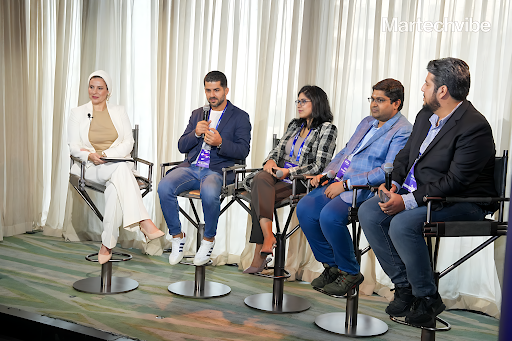
Excerpts from the panel discussion;
Bring in the full context for teams to align
“Recently, we had a meeting where teams across marketing, transformation, and contact centres were in the same room discussing the topic of customer obsession or customer concentricity – we want to drive better experiences, we want to get our NPS up, everything.
But every single team had a different explanation or a different idea of experience. For marketing, it was engagement, while for operations, this means efficiency, right?
So what we did was we picked a real-life case – a mother who ordered a kid’s gear and waited three days for delivery, got the wrong size, and now is struggling with the return. So, when we map the journey, everybody can see where they fit in.
They could visualise where they played a role, where my brand sentiment is going down, and that’s why it might affect my marketing numbers, or I ended up sending the wrong size, and that’s why my efficiency is going to take a hit. So, that’s how you connect the journey.
Collaboration is so important. Maybe, as a function, it is doing great. But when you bring different functions together, it has to have one holistic approach towards a customer.”
- Sagarika Nayak, Group Director – Customer Experience and Service Excellence at GMG
Don’t look at air as a tool, but as a transformation
“How do you transform your business? Instead of saying — how do I use the AI tool to do certain things, ask How do I use AI?
What was done by too many people earlier can be done with one agent today. This is true. But instead of approaching it as a way to automate certain tasks, put the customer in the centre and see what you can do better in terms of adding value. The use cases will be clear by itself after that.
When thinking about addressing the skill gap, also think of the fear of AI. Your workforce is asking themselves — am I going to be irrelevant? I think that thought is hindering people to look at how AI can enable them to do more or enable them to innovate better instead of seeing AI as a competitor.
Of course, an AI agent is going to sit next to you as a competing agent and has better numbers than you, but it is not about getting the right answers. Today’s world is about asking the right questions because AI is going to give you the answers, so how do you do that? How do you make your people ask the right questions?”
- Arjun Ranganathan, Associate Director, SAP Services at Infosys
Take a piecemeal approach, but keep moving forward
“AI is here to stay; we shouldn’t be afraid of that. We, as leadership, need to understand how to crack it one bit at a time. Try to build it small because we do have a lot of legacy systems to account for. Work on awareness. When you recruit people, make sure you have a growth path or a learning path drawn out.
For example, working in the automotive industry, we have a lot of people who are into sales. We put them into sales training, after-sales, product conversion, closure, service as well. Add training on AI and CX.
Basically, give them a full view of the value chain. Take a piecemeal approach, but keep moving forward. Learning is fundamental, then we scale.”
– Sami Skaff, Chief Digital Officer at Al Nabooda Automobiles
Show quick wins to help change management
“We know that each team has different KPIs; it could be time to value, it could be conversion uplift, and it could be efficiency for ops. The idea is to have these individual team KPIs align with a common goal for the business.
Starting small, show quick wins because when people see that it works, they will stick to it. They will understand that it could help each team meet their targets and the larger goals, and that helps change management.”
– Younès Ben Maïz, Regional Vice President EMEA South at SAP Emarsys
Conclusion
When teams across marketing, sales, product, and customer service view AI with scepticism, this resistance can manifest as passive disengagement or active pushback, slowing adoption. The fear stems from the threat of job displacement, but also the relevance of AI to their specific roles.
Another concern is skill readiness.
AI requires new competencies—data literacy, model interpretation, and digital collaboration—that many in the workforce may not yet have developed. Without structured learning opportunities, these individuals risk being left behind, creating a divide between “AI insiders” and everyone else.
Leaders are tasked with the responsibility to show every role how AI contributes to the larger goal of improving customer experience.
As Nayak concludes, “Any time you introduce a new tool or a new process – people resist. I think more than making it like a process-driven change, it should be like a purpose-driven change. People should understand what’s in it for them, how it impacts them to do their role better, faster, and create the experience that the organisation is looking at.”
ALSO READ: When Billboards Think: Ethics and AI in the Future of DOOH